Snapping
Snapping affect how tools and interface elements in Valence 3D behave. When snapping is enabled most tools will snap to increments of 0.05 units or will snap to the grid and/or the subgrid. Snapping can be configured in the Settings Sheet.
Snapping behavior is different for each tool. The move and scale tools snap to the grid and subgrid intervals. The rotate tool snaps to 5 degree increments. Other tools, such as the extrude and inset tools snap to increments of 0.05 units.
On iPhone, you'll receive haptic feedback when a tool or interface element has hit a snapping threshold. On iPad, you'll know when you've hit a snapping threshold because the number on the visual measurement helper will be a multiple of the snapping increment.
To configure the snapping options, long press the snapping button, which is located on the bottom left corner of the screen (see below).
Snapping Sheet
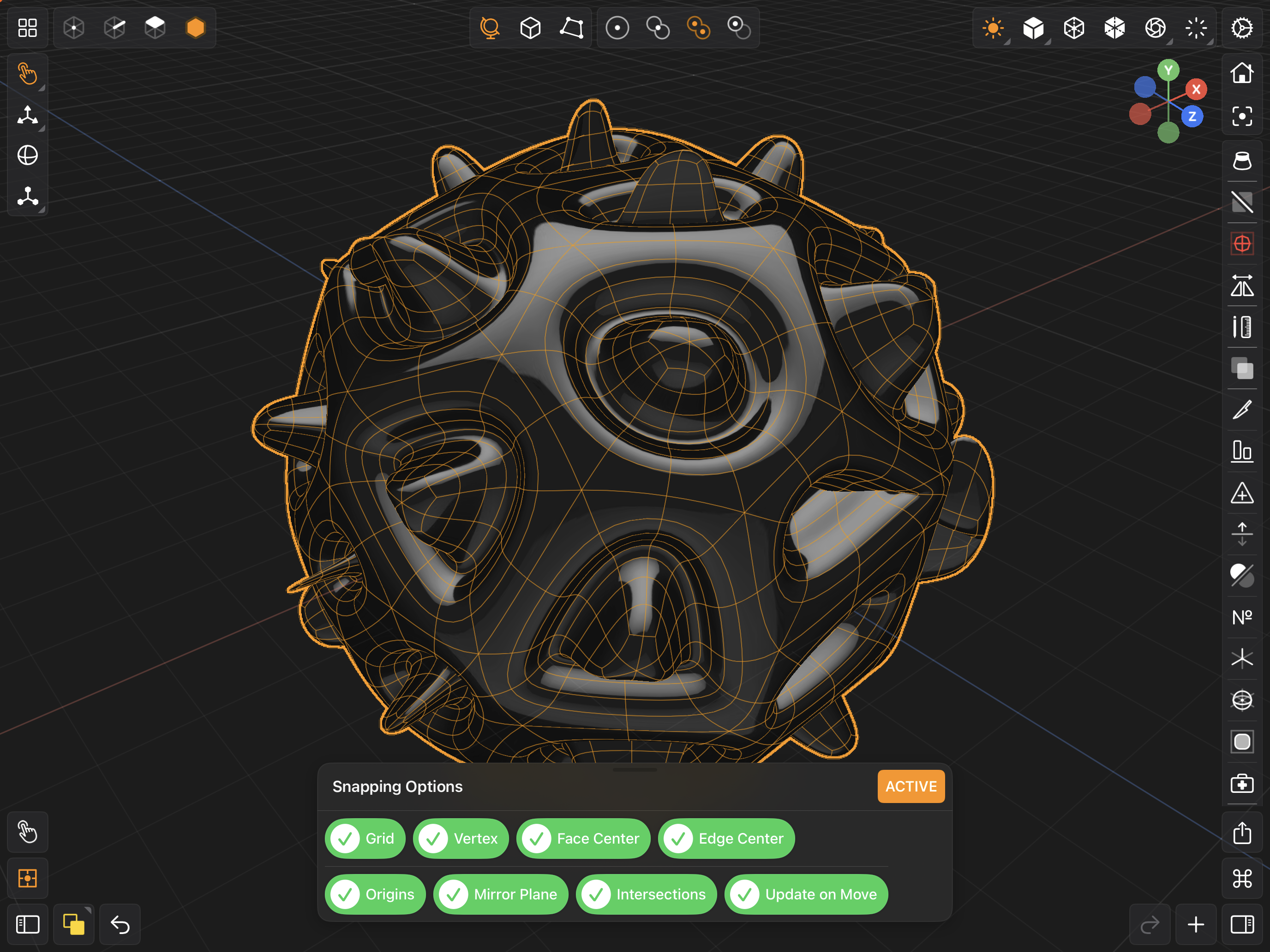
Tapping the snapping button toggles snapping on and off. Long pressing it opens the Snapping sheet, which holds the same options as the Snapping Settings page — whichever you change, both stay in sync. The ACTIVE button in the sheet's header is the master switch: when it is off, none of the options below have any effect.
Snapping to the Grid
Grid
Grid snapping is on by default. It makes the move tool snap to the grid and subgrid lines as the gizmo passes near them. The subgrid interval is 1.0 / Grid Divisions, so at the default of 4 divisions the tool lands every 0.25 units. With Grid off, snapping falls back to whole grid units.
The number of divisions is set by Grid Divisions, which is the same setting shown in the Scene Settings.
Snapping to Geometry
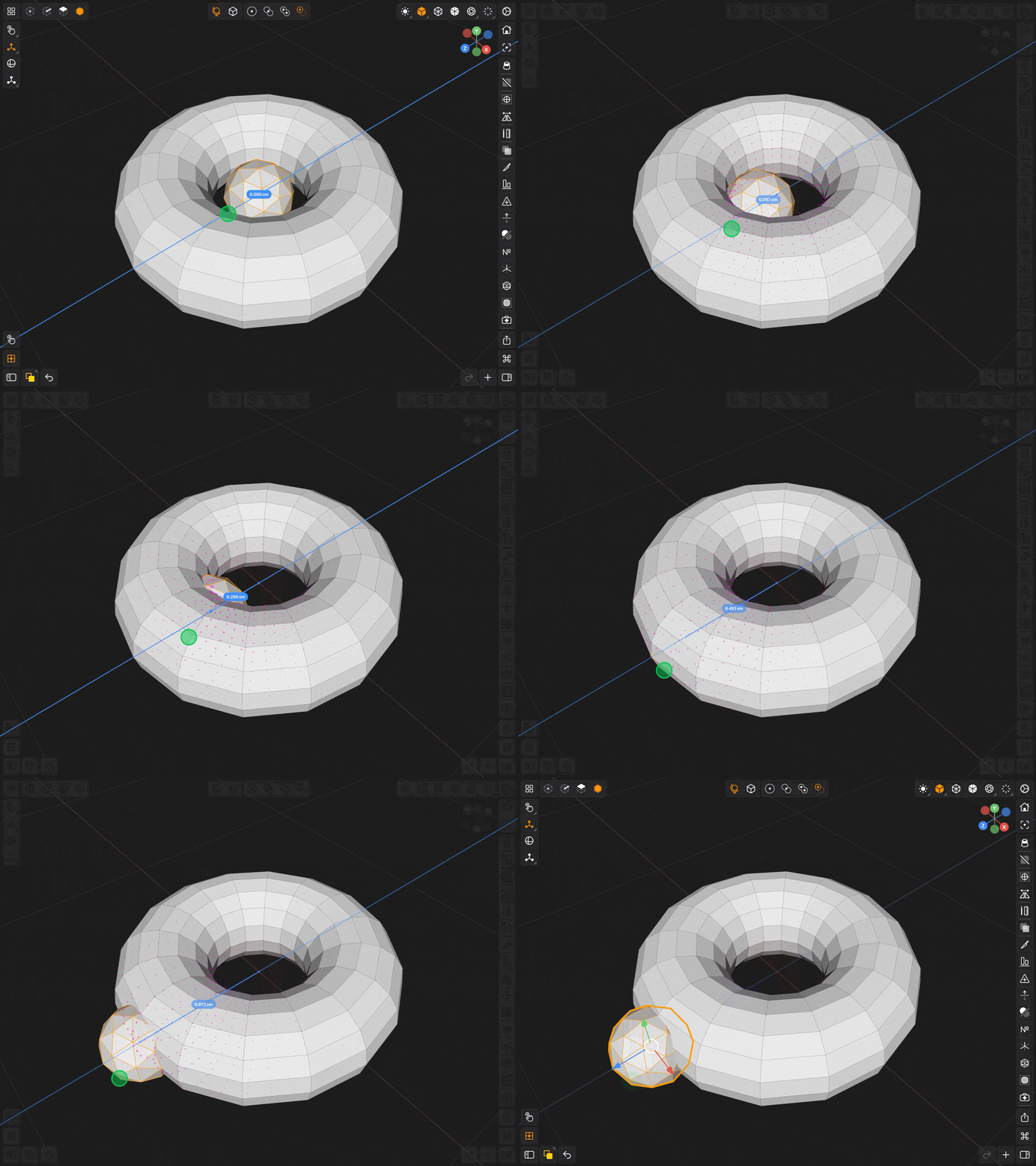
Beyond the grid, Valence 3D can snap to the geometry already in your scene. As you drag, nearby snap targets appear as dots and the tool jumps to the closest one. These options are all on by default.
Vertex
Snaps to the positions of vertices on nearby meshes. In Vertex selection mode the vertex you are currently dragging is excluded, so it can't snap to itself.
Face Center
Snaps to the center of nearby faces. In Face selection mode the face you are currently dragging is excluded.
Edge Center
Snaps to the midpoint of nearby edges. In Edge selection mode the edge you are currently dragging is excluded.
Origins
Snaps to the origin (pivot point) of nearby meshes. This is useful for lining one mesh's pivot up with another's.
A mesh's origin is wherever its pivot sits, which is not necessarily its visual center. Use Center Pivot if you want the two to coincide.
Intersections
Snaps to the point where your touch intersects the surface under it, rather than to a specific vertex, edge or face feature. This lets you drop a selection anywhere on another mesh's surface.
Mirror Plane
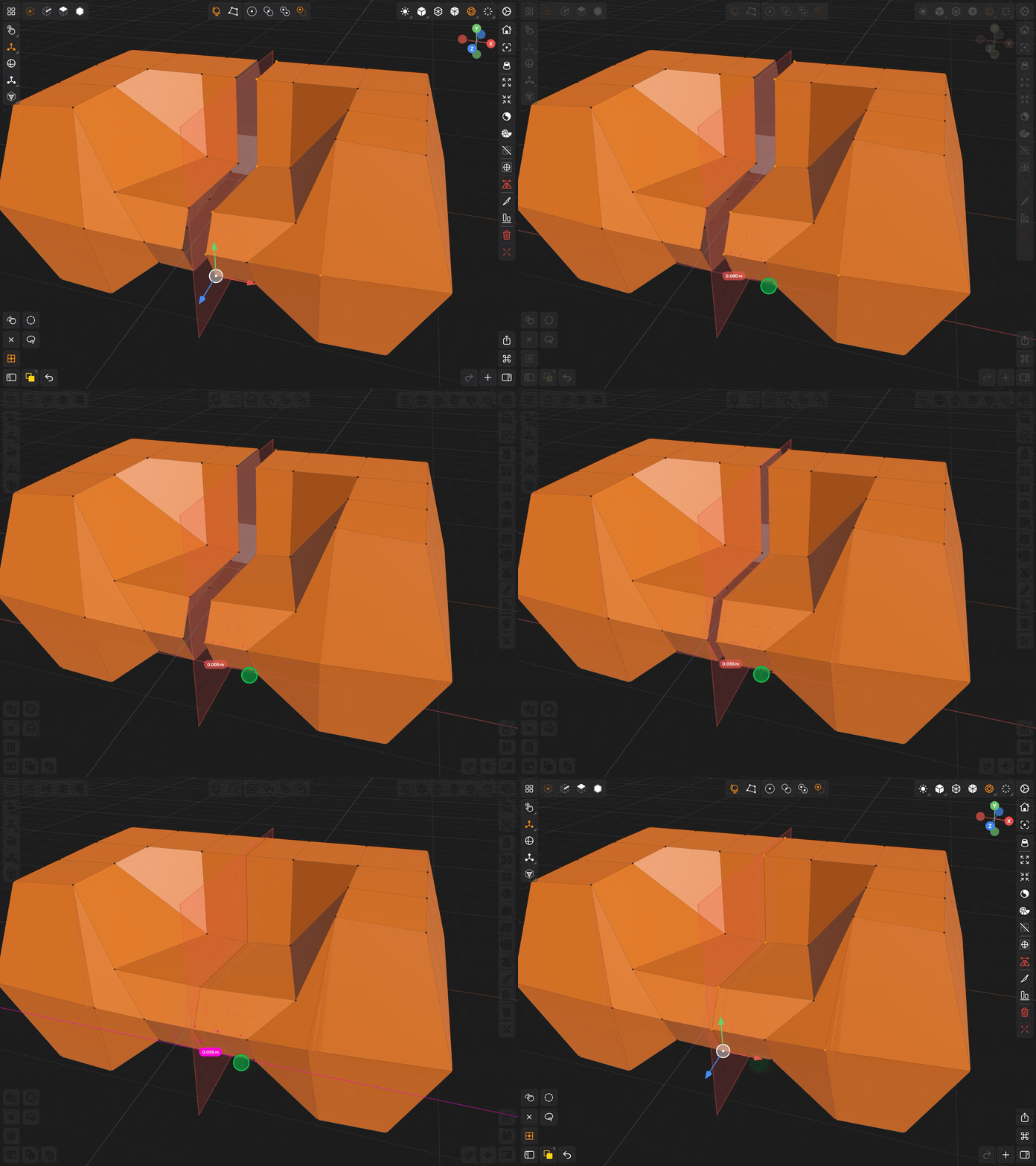
When the mesh has an enabled Mirror Modifier, this snaps the vertex you are dragging onto the mirroring plane. This is how you weld a half-model's boundary vertices flat against the plane so the two halves meet cleanly.
Snapping Behavior
Update on Move
On by default. When Update on Move is on, Valence 3D recalculates the available snap targets continuously while you drag along an axis, so geometry that comes within range mid-drag becomes snappable. When it is off, the snap targets are gathered once when the drag begins. Turning it off can help on dense scenes where recalculating causes the drag to stutter.